Dry-type transformers
Cast resin and vacuum-impregnated options for building and industrial applications. Select enclosure, insulation, cooling and ventilation for the installation.

 Let’s talk ↗
Dry-type, oil-immersed and pad-mounted transformers selected for the voltage, load and installation.
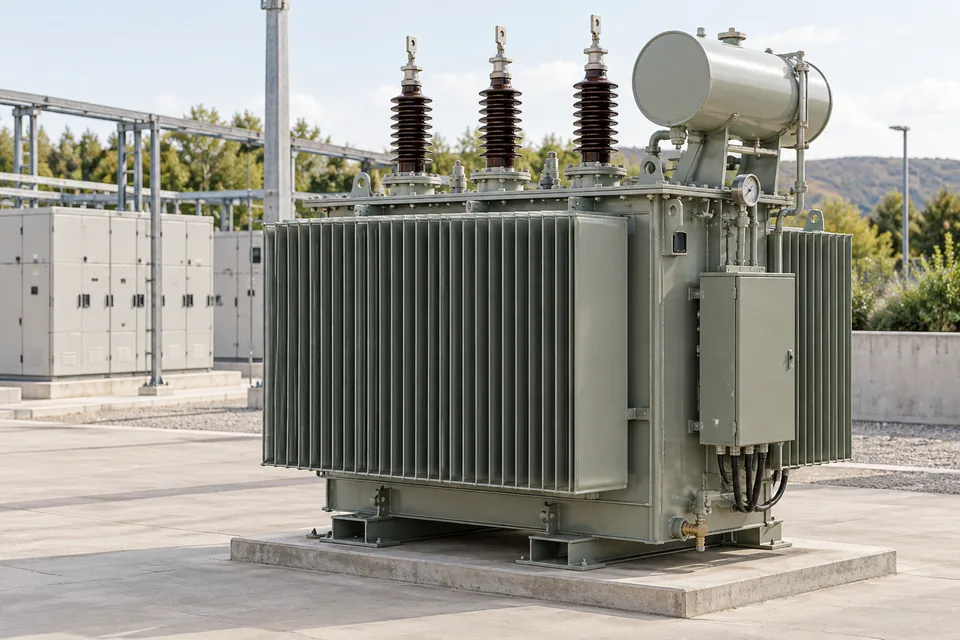
Compare voltage ratio, impedance, losses, cooling, protection and maintenance alongside rated capacity. We match the requirement to manufacturer information.
Cast resin and vacuum-impregnated options for building and industrial applications. Select enclosure, insulation, cooling and ventilation for the installation.
Distribution and power transformers for site and network connections. Assess cooling, oil containment and maintenance access.
Enclosed outdoor distribution options. Confirm connections, access, protection and local requirements.
Confirm ratings, compliance evidence and availability for the selected model.
| Parameter | Family / selection basis | Project consideration |
|---|---|---|
| 6 / 10 kV class | 30–2,500 kVA | 0.4 kV secondary in the published distribution range. |
| 20 / 35 kV class | 50–2,500 kVA | 0.4 kV secondary in the published distribution range. |
| Cooling | Natural air; forced-air option | Confirm enclosure, temperature rise and installation conditions. |
Selected SC(B) distribution range in manufacturer material reviewed August 2026. Ratings are configuration-dependent, not all available in every combination.
Request the model datasheet ↗| Parameter | Family / selection basis | Project consideration |
|---|---|---|
| Voltage ratio & frequency | Primary, secondary and system frequency | Match the utility or site supply and downstream equipment. |
| Rated power & loading | Required kVA or MVA, duty profile and growth allowance | Consider actual loading, redundancy and operating conditions. |
| Winding arrangement | Vector group, earthing and impedance | Coordinate with fault levels, protection and parallel operation where relevant. |
| Cooling & insulation | Dry-type or oil-immersed configuration | Confirm thermal class, cooling mode, ventilation and ambient conditions. |
| Losses & sound | Model-specific no-load, load-loss and acoustic data | Compare at the same rating, reference temperature and measurement basis. |
| Acceptance | Agreed routine tests and relevant type-test evidence | Confirm the test basis, witnessed activities and document handover. |
Coordinate transformation with distribution, resilience architecture and high-density load growth.
Select around the load profile, available space, operating environment and maintenance access.
Assess step-up duty, power-conversion interfaces and the connection requirements.
Compare dry-type, oil-immersed and pad-mounted options against the same load, environment and installation requirements.
A datasheet, general arrangement, losses and impedance data, terminal layout and applicable routine/type-test evidence.
Tell us what you’re planning.
Technical details can follow.